Sunday, June 1, 2025

Incentivizing Death

This one does what it says on the tin.

I have been told I'm a contrarian. That I have a strong aversion to authority. I am rather infamous in my friend group for having the highest reactance—the quickest way to ensure I never do something is by telling me to do it. If you think that sounds annoying, I can assure you my friends agree. Thankfully, they have found plenty of other reasons to love me anyway. 

I'm sure it's not difficult to see how my personality can put me at odds with something like, say, a book that says, "here are rules for playing a game. Follow them." Which is why I love when a book presents them as suggestions. Oh, I can use whichever ones I want? Cool! I'll try them all out, at least for a while, and then change to taste. 

On top of that, I also headbutt with prevalent attitudes held by ttrpg communities. Nothing makes me want to make a PbtA dungeon crawler more than seeing people say it wouldn't work. Same goes for skill systems in OSR games. But sometimes it goes deeper than that. 

For example, sometimes I see people in OSR spheres discussing character death, and I think, "what if we incentivized death? What if we rewarded it? What would that look like?" Well, if we used the lingua franca of OSE/BX, maybe it would look like this.

Death, Advancement & The Mythic Underworld  

The deadly dungeons and strange subterranean places adventurers delve into is a different world, a universe unto itself. The player characters are interlopers into the Mythic Underworld, which rejects them—even in death.

Rule 1. Don't be a weasel. This first rule is taken straight from Blades in the Dark. No getting into combat and refusing to fight, that sort of thing. You're still playing a character who wants to live, because dying still kind of sucks. Surviving a fight is probably a step toward a larger goal, and dying puts you further from accomplishing that. Plus, it now it changes you. More on that shortly.

Rule 2. There is no XP. Gold for XP naturally leads to the question, "why does my character need all this gold? Why are they willing to risk their life to get it?" Those questions are still in play. You've made a little freak and are sending them off into freaky places, figure out why they're doing that.

Rule 3. When you hit 0 HP, you're taken out of action. You're dead, but the Mythic Underground won't accept you. Once the battle is over, the trap is overcome, etc. you come back. Hopefully your party members brought your body along. If your body was destroyed, it materializes where you were last out of harm's way.  

Rule 4. When you return to action, you level up. That's right, you heard me. It's probably a good idea to start leveling your character up as soon as you're taken out of action, that way you're ready to go once your surviving party members finish up with what killed you in the first place. 

Rule 5. When you return to action, you've changed. When the Mythic Underground bludgeons your soul back into your body, it leaves a little bit of itself with you. Roll on the following d84 table and note the way your character is different now.

1. You grow vistigial... 
    1. Wings 
    2. Tail
    3. Tusks
    4. Antlers/horns

2. Another 1d4 eyes appear on your...
    1. Head
    2. Arm
    3. Torso
    4. Leg

3. Your hand becomes...
    1. A crustacean claw
    2. Tentacle-fingered
    3. A snake's head
    4. A bird's foot

4. Your legs become that of a...
    1. Sheep
    2. Feline
    3. Lizard
    4. Aphid

5. You grow another...
    1. Arm    
    2. Leg
    3. Mouth
    4. Row of teeth

6. Your head becomes that of a...
    1. Mantis
    2. Wolf
    3. Bat
    4. Frog

7. You have...
    1. A tongue that forks like a serpent's
    2. A third eyelid that blinks horizontally
    3. Translucent skin
    4. A second, discordant voice

8. Your...
    1. Mouth(s) become a beak
    2. Hair is replaced by feathers
    3. Shadow moves slower than you    
    4. Ears grow fingers

Rule 6. When you have changed a number of times equal to your maximum class level plus one, hand your character sheet over to the referee. The transformation is complete. Your character is a part of the Mythic Underworld now. The referee should play them as they would any other powerful underground-dwelling NPC. Like most other denizens of the Mythic Underworld, they now stay dead when killed. 


Well, there it is! I have not tried it. I may never try it. But it was fun to come up with. I like the idea of this otherworldly place rejecting you until it transforms you into something it will accept. I like the potential roleplaying consequences of adventurers delving over and over, returning to the World Above more alien the more powerful they become. I like that if I do end up using this, my players would undoubtedly engage with more of the danger I telegraph. 

If you have or do come up with a way to incentivize character death, let me know about it here or on Bluesky.

Wednesday, May 7, 2025

Rites of Castage

This one's about clerics, and going all-in.

Who am I to resist a Prismatic Wasteland prompt? Religion is usually given as little attention as possible at my tables. I am on-record as saying my inevitable OD&D hack will not feature clerics, but instead a secret third thing. So yes, I have all the usual misgivings about religion and clerics in elfgames.

Perhaps my biggest problem with clerics is they tend to show up in Generic Fantasy Games. I think out of the core three (or four) classes, clerics suffer the most from generality.  We can't fill in the blanks like we can with a fighter or wizard because there are no cultural touchstones for the strange Templar-cum-vampire hunter set before us.

So when do they work for me? When a game doesn't water them down. The first one that springs to mind is the Priest supplemental class in Outcast Silver Raiders, there's some nice specificity about a deity revoking spells in there. And it got me thinking, what would my specific cleric look like? How would I go all-in?

Let's Get Clerical, Clerical

Why do clerics just get their spells? The answer in most OSR games is, "magic-users must learn them, clerics must earn them." They seem to do that most often by simply... reaching level 2. How boring! If clerics are the righteous vessels through which a deific entity enacts its will upon the world, then faith should be something they do.

Prismatic Wasteland's blog about clerics states, "Magic must always be dangerous, whether arcane or divine." What if that danger was front-loaded? What if a cleric had to face personal risk or responsibility to get each and every spell their deity granted them?

Well, if we used first level OSE spells, maybe it'd look like this:

Cure (Cause) Light Wounds
Seek no aid for a grievous wound, having only faith that it will heal. 

Detect Evil
Raise not your hand when an evil act befalls you, and witness fully a hate-filled heart unbound.

Detect Magic
Allow the arcane to wash over you, unresisted, and may you know it well. 

Light (Darkness)
Let faith be your light in the dark, blindfold yourself from all other sources.

Protection From Evil
Stride into danger armored only in your faith.

Purify Food and Water
Spend all your riches and a week of your time feeding the poor.

Remove (Cause) Fear
Go where none would dare tread, alone.

Resist Cold
Provide shelter to one without, that they may know the warmth of body and spirit. 


Sunday, April 27, 2025

The Woods Are Alive

This one's a random table of animals. I made it for personal use, but maybe you'll find a spot for it at your table. 

Want to breathe life into your forests? Talk about the animals. It doesn't have to be much, just a sentence or two. Do it whenever the mood strikes you, or when your players' eyes start to glaze over, or when there's not a random encounter. 

Here's a table of 20 animals, with descriptions of what they're up to. I bolded the animal so you can easily grab it and make up what they're doing on the fly. These are ones found in the coniferous forests where I live, and have seen in the wild (minus number 20). 

1. A pair of squirrels bound through the creaking tree branches in a high-stakes game of tag.
2. A hare bolts across your path, running from something that thought twice about approaching the party.
3. A white-tailed deer picks her head up from grazing and watches the party for a moment before gracefully bounding off, two clumsy fawns in tow.
4. A red fox swiftly digs a hole to bury its leftovers.
5. A remarkable number of bees drone around the party before deciding they don't contain nectar after all.
6. Ravenous mosquitoes descend on the party every time they enter shade.
7. Clouds of gnats hover along the trail, flying into unsuspecting noses, ears, and—gods forbid—mouths.
8. You catch glimpses of a marten in the underbrush as it hunts.
9. A porcupine waddles down the trail, untroubled.
10. You hear the staccato hammering of a woodpecker long before you see it up in a tree.
11. The quiet is shattered by the drumming of a ruffed grouse perched on a nearby log.
12. A cheerful choir of bluebirds flit between branches overhead.
13. A robin preens itself before taking flight.
14. A family of chickadees dart back-and-forth between the ground and a nearby tree.
15. A chipmunk scurries up a tree and begins to furiously chitter at the party.
16. Frogs croak and hop along the edge of a pond.
17. Butterflies lazily drift from bush to bush.
18. A black bear stands on its hind legs to get a better look at the party before meandering off.
19. A gray owl gazes imperiously down as the party passes under its tree.
20. A bobcat makes an impossible-looking jump up into a tree, a rodent dangling in its mouth.  

Tuesday, April 15, 2025

Tenacious Clocks

This one's about clocks. And to a certain extent, hit points. But mostly clocks.

You know, those things from Apocalypse World. Though nowadays most people probably associate them with Blades in the Dark, as linked above. Some games use countdowns instead—I tend to do this, especially in games that don't feature clocks already. Either way, some sort of progress tracker being a built-in game mechanic has been in vogue for quite some time.

And I love it. Especially when I crack open an OSR/NSR book and see them as a feature. I appreciate that they're not everyone's cup of tea, and it doesn't take much looking to find clock critics. "It's just hit points for consequences," is a common refrain I've come across, especially when it comes to the Harm Clock as seen in Apocalypse World.

The Harm Clock has 6 segments, and once all segments are filled you are taken out of action and possibly die. Which is a lot like having 6 hit points. Except, it's also a wounds/injury system. 

Here's a primer/refresher: Harm before 6pm (the first 2 segments) heals on its own. Harm from 6-9pm (3rd segment) doesn't get worse, but doesn't get better by itself. Harm after 9pm (segments 4-6) gets worse unless stabilized and won't heal without medical attention. It also states that harm should progress rapidly if the character is being active. 

That's some heavy lifting from a little circle with 6 segments. It's a visual representation of dramatic tension that doesn't just hit a payoff when the progress is complete, it happens along the way as well. One might even say that little circle is a...

Tenacious Clock

A tenacious clock is just what I decided to call a clock that has consequences before striking midnight. Most games don't use tenacious clocks, because most clocks don't need to be sticky like that. And yes, you could potentially use linked clocks instead of a single one, but where's the fun in that? 

I'd like to see more of these things in games. Hell, I'd like to make more of them myself. So on that note, here's a tenacious clock that I could easily stick into any dungeon crawler that I run.

Saint Aoife's Hounds

When the Relic of Saint Aoife is removed from her burial chamber, her Hounds awaken and the Hunt begins. This is an 8-segment clock. For every hour the characters remain in the cairn, a segment fills. Once they've left, a segment fills each day spent in the same location. After 4 segments, the Hounds start accosting anyone the characters come into contact with. After 6 segments, only crossing large bodies of water or equivalent magic or enchantment can get the Hounds off their trail. When the clock fills, the Hounds have found their Prey. May Saint Aoife have mercy on your souls, because they certainly won't.

Wait, I have an idea for another one. This one could fit into Blades in the Dark, or any game where a player character is a charlatan. I like this one because it involves two linked clocks, but they don't start at the end of the first.

The Scam 

Selling snake oil is a medium-length con, this is a 6-segment clock. Every time you run this con (make a significant sale, run advertising, etc), mark a segment. After 3 segments, the victims' loved ones take notice—make a new clock called "Vengeance." After 5 segments, the authorities have taken notice—make a new clock called "Wanted for Questioning." When the clock fills, the public has caught on to your scam and will no longer buy your elixir. 

Well that was fun! I think I've been ignoring how much drama a clock can hold. I'm excited to not make that mistake going forward. If you use clocks and either have or end up making some tenacious ones, I encourage you to share them with me either in the comments or on Bluesky.


Tuesday, February 25, 2025

Omino Spells

This one's about gamifying spell memorization.

I recently read The Dying Earth by Jack Vance for the first time. While it didn't change my opinions on Vancian magic in fantasy roleplaying games, I can appreciate why a bunch of people in the 70s and beyond were like, "yeah that book is cool, let's do it like that." In certain situations, I also want to do it like Jack did—just not every time I play a fantasy dungeon crawler. 

I hadn't given any of this much thought since finishing the book, until a question popped into my head today: how do they fit in there? The spells in Vance's world occupy wizards' minds until they are unleashed, taking up (meta)physical space. Marizian the Magician is so powerful he can memorize six normal spells, or four of the most powerful ones. What does it look like inside his head when he does that? 

Old school D&D cares a lot about replicating the feel of the spell-slingers that wander the Dying Earth. A level 1 Magic-User can memorize a single instance of a level 1 spell. It doesn't care much about how that arcane formula is stuffed into the aspiring wizard's mind, just that it is crammed in there. 

What if there was a game that did care? What would that look like? Well, maybe it'd look like Tetris. Or any video game with a grid-based inventory. Or Mausritter's inventory system. But this time, in your brain! Maybe a novice thaumaturgist starts with a mind hovel and grows in power until they have a mind palace to house their spells.

It just might look like this.

The Mind is a Fill-able Thing in Space

This is a proof of concept more than anything. I will reference various things from D&D, but this isn't a fleshed-out system designed to be used with a particular edition of any existing game.

Anyway, check this out: 
 
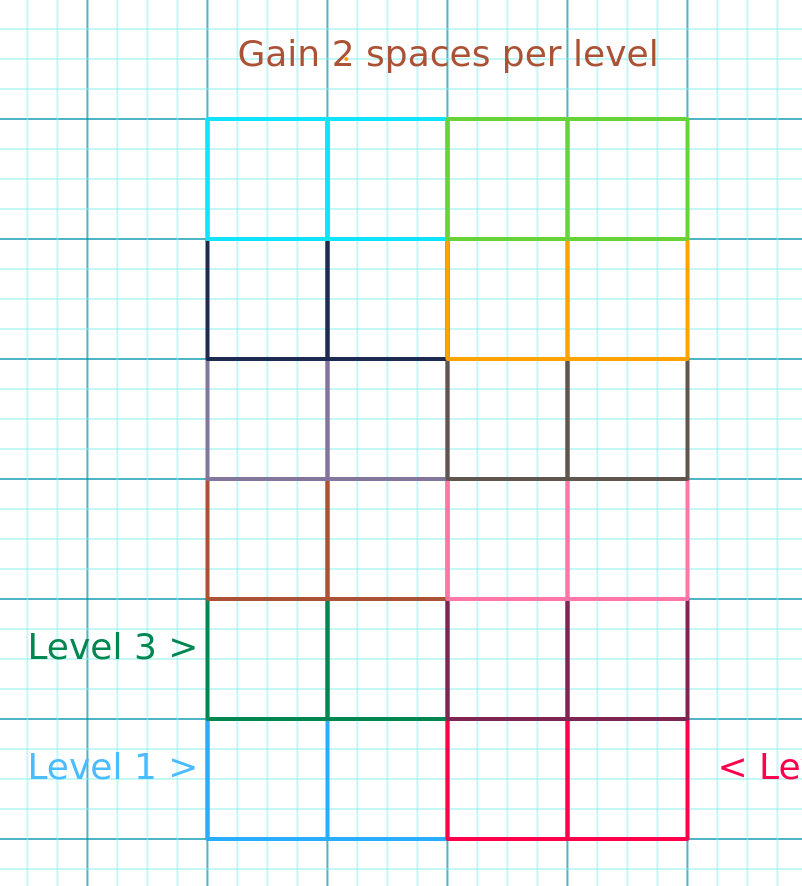
grid paper with different color boxes, 2 of each color side by side. it is 4 boxes wide and 6 boxes high, which results in there being 12 different colors. text above reads: Gain 2 spaces per level. text to the left of the bottom left box reads: Level 1. text to the right of the bottom right box reads: Level 2. text to the left of the second to bottom box reads: Level 3.

So you start with two boxes of space for spells. If you're playing a game with cantrips, maybe those would take up one box, allowing you to memorize two relatively weak, non-damage dealing spells. A level 1 spell like Sleep would take up two boxes. Maybe level 2 spells would take up 3 squares. From there, spells could start taking the shape of tetrominos, like the ones in Tetris.

the five tetrominos, a geographic shape composed of 4 squares.
By Anypodetos - Own work based on: Tetromino Tiling 5x8.svg by R. A. Nonenmacher., CC BY-SA 3.0, https://commons.wikimedia.org/w/index.php?curid=8663361

Even more advanced spells could take the form of pentominos, like this:

the 18 pentominos, plane polygons made of 5 squares of equal size connecting edge to edge

The spell-caster finds or copies spells into their book, each spell has a shape, and every day the conjurer pours over their spellbook, rotating and arranging their spell choices to fit into the canvas of their mind. 

Is it practical? Hell no. Would it be fun? Highly subjective. Would the spells leave your brain once cast, like Vancian magic? Who knows! Has it been done before? Probably! But I'll be damned if I could find it.


Saturday, February 22, 2025

Another Kind of Factions

This one's a draft of faction rules using Otherkind Dice. Which is to say, I haven't tried it. Yet.

I love factions. They're like the MSG of roleplaying games, their inclusion makes everything taste better. I also adore when a game has GM turns that happen in-between sessions. Especially when there's mechanics involved. For me, few things make prep more fun than getting to play a little mini-game during it. 

Recently I was looking at the faction rules in Mausritter. They're great! The goal progression results reminds me of an Otherkind result card, only there's just one question being answered. Which is elegant in its simplicity, but got me to thinking, "what would other result cards look like?"

Design Goals
"What am I trying to accomplish?" is a wonderful question to ask yourself repeatedly when you design something. It's can be easy to get the ball rolling, and even easier to continue chasing it to straight to catastrophic failure. I can't tell you how many times I began working on something, followed inspiration, incorporated it into a game night and went, "well, that sucked." So I started with that north star query.

"Make a faction system that tracks fallout and debt as factions make moves." There it is. I want something that determines how the public and other factions (enemies and allies) react to a faction moving toward their goal. I want factions to be able to interact with one another via debt. 

Faction Stats
As far as this system is concerned, factions have resources, goals, public reputation, faction reputation, and debt.

Resources are what factions use to accomplish their goals. They could be something concrete like a cavalry troop, or intangible like blackmail on members of the high council. Resources come into play in the form of dice, which is determined by the strength of the resource. They can either be standard (d6), diminished (d4), or enhanced (d8). Factions start with two or three resources, depending on their size.

Goals are, naturally, what the faction is trying to accomplish. I would use clocks, or progress marks as Mausritter calls them, ranging between two and five segments (or marks). If a goal seems too big to accomplish in five segments, then it should be broken up into a series of goals. "Usurping the king," for instance, probably has a few smaller goals before a faction could achieve the big one. 

Public reputation is the general attitude of different populations toward a faction. I imagine this to be regional. A thieves guild might start off with a favorable attitude with farmers in the countryside ("stick it to those richie-riches in the city!") but disfavored by the citizens in the city they operate ("that's my purse! I don't know you!"). It could also be done on a smaller scale, like a church that the lower class of a city adore for their charity but the upper class resent for their tithes. 

Faction reputation is how factions feel about one another. I can think of two ways to implement this. The first is simple: two factions always feel the same about one another. So if one faction views another as the enemy, the opposing faction does as well. The other is more complex, and a faction's attitude toward others is independent of their attitude toward them. This would require more bookkeeping, but would result in things like Faction A viewing Faction B as an ally, while Faction B sees them as an enemy and works surreptitiously to undermine them. That sounds cool as hell to me! 

Either way, both public and faction reputation would be tracked numerically. 0 being neutral, with -6 and +6 representing hated and loved respectively. For public reputation, the score would help me roleplay NPCs the players encounter. For faction reputation, it would both help me roleplay faction NPCs and also make decisions during the faction turn. If Faction A has a -3 reputation with Faction B, Faction B is going to interfere with Faction A's plans when convenient. If it's -6 instead of -3, Faction B is going to interfere at every possible opportunity. If it's a +6, Faction B might abandon goals that run counter to Faction A (especially if B is the smaller faction). 

Debt is what it sounds like. One faction can ask another to lend resources. They then take on a debt, which is repaid by lending their resources to the faction that helped them. It's a way to incorporate and track the political machinations of these organizations in their quests for power. More on how debt actually works below.

Does that all make sense? I hope so. Anyway, how do we actually play the mini-game? We grab some index cards, some dice, and prepare for...

The Faction Turn
Factions act in-between sessions, lowest number of resources to highest. Smaller organizations are able to mobilize and act more quickly, but larger factions are able to interfere more easily because of this. 

At the start of a faction's turn, they pick a goal to make progress toward. Then, they select any number of their resources they could reasonably use to accomplish that goal, and grab the appropriate dice. Don't roll yet!

If they do not have enough resources to answer every index card, or they want a better chance of success, they may enter into debt or call in what is owed with another faction to add more dice. They may enter minor debt (d4, owe them 1 time) or major debt (d6, owe them 2 times). If they have negative reputation with the faction they ask for help, double what is owed in return, but once the debt is repaid their faction reputation increases by 1 for a minor debt, or 2 for a major debt. Calling in a debt gives the lender equivalent sized dice to what the debtor received.

Lastly, factions can interfere before the roll is made. For every resource die an interfering faction decrements in size, they can likewise decrease a resource the acting faction is using this turn. 

Now, on to the result cards. Roll the dice and place as you wish. 

Notes: Unless otherwise stated, a new resource acquired from accomplishing a goal starts as diminished (d4) for two turns. Likewise, any enhanced resource (d8) automatically decrements to standard (d6) once it it used.

Does the faction make progress towards their goal?
7+: Yes, major progress (2 segments), and if this results in acquiring a new resource it begins at standard (d6).
6: Yes, major progress (2 segments).
3-5: Yes, minor progress (1 segment).
0-2: No, they suffer a setback (-1 segment).

Does the faction exhaust resources working toward their goal?
7+: No, they don't, and if an enhanced resource (d8) was used, it does not decrement.
5-6: No, they don't.
3-4: Yes, one is diminished next turn.
0-2: Majorly. Two are diminished, or one is diminished for two turns.
If the resource chosen to be diminished is already a d4, that resource is lost instead.

How does it affect their reputation with the public?
7+: Public opinion in the area skyrockets (+2 rep), and word of this is received well elsewhere (+1 rep with another population).
5-6: Public consensus in the area is positive (+1 rep).
3-5: It's split. Some see it as good and others use it as further fuel for their mistrust or animosity (no change).
0-2: The public consensus is negative (-1 rep). 

How does it affect their reputation with other factions?
7+: As 6, but +2 rep with one ally and +1 rep with one enemy.
6: Allies react positively (+1 rep), enemies are neutral (no change).
3-5: If a debt with them was entered, they react positively (+1 rep). Otherwise, allies are neutral and one enemy is upset (-1 rep).
0-2: One ally reacts negatively (-1 rep), and one enemy is incensed (-2 rep). 

There it is! As you can see, there are four index cards to answer. Factions start with a maximum of three resources, which means they will either be incurring debt immediately or facing the harshest consequences for their moves. Likewise, each card has a 7+ result that can only be gotten by placing an enhanced resource (d8) there. 

Like I said up top, I haven't tested this yet. It existed as a couple of paragraphs on a notes app in my phone before I typed it all out into this post. Now that I don't have to ask myself, "what did I mean by that?" I can give it a go. There are some questions I don't have an answer to yet, like, "does lending a resource take it out of play for the turn?" I hope to get my answer by trying it both ways and seeing for myself how it feels. I'm excited to take it for a spin in solo play before bringing it to one of my tables. Hopefully it inspired you to think about different ways you can run factions. And if you happen to try this way out yourself, let me know how it goes!


Sunday, February 9, 2025

Life is Likely Hurt & Pain

Here in
DUKK BÖRG.

This one's a review. Of DUKK BÖRG by Gem Room Games and Nerdy Paper Games. It's a DuckTales-themed hack of MÖRK BORG.

Let's get the disclaimer out of the way first. This is about as biased as as a review as you're likely to find. One, Dan Phipps of Gem Room Games and I have been mutuals on social media for a few years at this point, I don't remember how many. Talking about games with Dan is a blast. I'm probably going to go into any of his work expecting to enjoy it, even if it's not particularly my jam.

This, however, is extremely my jam. I grew up on a steady diet of DuckTales, Darkwing Duck, Chip & Dale's Rescue Rangers, and Sonic the Hedgehog. You give me a game where I get to play around in those worlds, I am all-in. Hell, just let me be a duck or a mouse, even! I spent an embarrassing number of hours in 2020 playing Animal Crossing New Horizons looking like this:


Like, hundreds of hours.

Speaking of which, I should probably pick up Dragonbane at some point. 

Anyway, I bought DUKK BÖRG. Then I read it. Then I played it. Let's get into it.

Part 1: The Book

I backed the physical copy of the book when it went to crowdfunding. It's pretty, in the creepy way that many BORG games are. They nailed that MÖRK BORG-style layout, and between that and the art, it is very fun to look at. It is also less-practical to use at the table because of this. The book has a handy index on the inside back cover, and I saw they have a plain-layout pdf as well. I have ran plenty of MÖRK BORG only using the physical book, so this wasn't a hurdle for me. I could see it being a barrier to entry for others, though. 
 
This thing is fun to read. It is as stone-faced as it is silly. It dares you to take it as seriously as it takes itself (more on that later). The classes, locations—even the magic items—are rife with adventure hooks. The classes themselves nail the cartoon's archetypes, as does the equipment. Those world-ending psalms that are a hallmark of BORG games are just the DuckTales theme song. And like the theme song, they are repetitive. That might wear on anyone brave enough to live in this cartoonish hellscape for long-term play, but the text is challenging you to look at your players with a straight face and tell them what new thing is heralding the apocalypse with an oo-woo-ooo
 
Included is an adventure, The Aeonian Citadel. I ran it for the Tuesday crew, so without further ado...
 

Part 2: The Play

There are going to be some spoilers for the adventure. You have been warned!
 
My Tuesday table currently consists of three of my friends I have been playing games with for 8 to 20-ish years. One has played MÖRK BORG with me, the others have not.
 
They ended up making a Treasure Hunter, a Gizmo-Speaker, and a Devotee. Each of them had at least two classes they were interested in playing, deciding on one might have been the hardest part for them. One ended up rolling for it. The clan creation was a highlight for me, and a great way to tie the player characters together. I let them spend their starting silver on gear because the adventure plops you right in front of the dungeon and doesn't really let you leave. 

The dungeon itself is SKRUJ's tower, and it extends up into the sky and down into the earth. The length of it is indeterminable, because travel between each keyed floor includes a random number of unimportant floors. Unimportant, that is, unless there's a random encounter on them. My players got really lucky on those rolls, but luck has a funny way of running out.
 
See, the thing about the tower is that it's a race against time, but time only passes when the characters smell money. There are set, keyed money encounters, but they can also happen during a random encounter. If you smell money too much, game over. Once my players figured that out, the sense of foreboding only increased. 
 
Therein lies the beauty of DUKK BÖRG. The game, and by extension the starting adventure, is so full of Saturday morning zaniness that we ended up laughing and joking around. But it all rests on the bones of the incredibly dangerous MÖRK BORG skeleton. So it might be a funny mental image when a troupe of primary-color wearing ducks with slingshots pop out of a vent, but when it hits you that this is a life-or-death situation the game asks, "who's laughing now?" Like I said before, it dares you to take it seriously. There are consequences for not. 

My players decided to descend the tower, and I encountered my only hiccup in running it. See, I had read the entire dungeon when I first received my physical copy last November, but I only skimmed it before playing it last Tuesday. One subterranean floor has a freezer. 
 
The book tells you what temperature the freezer is at, and another section has a consequence for unplugging it. There's a cryptic label with letters missing on the freezer. Neither myself nor my players could figure out what was in the freezer. I'm not sure if the incomplete label refers to something in the real world, something from the DuckTales cartoon, or something I was supposed to come up with. It put me on the back foot, which was frustrating in the moment. In hindsight, I wish I had read through the adventure again in full and expanded on that dang freezer. 

But that was just a road bump during an otherwise action-packed, laugh-filled evening with my friends. Each keyed dungeon floor they explored was interesting, the multiple encounter tables kept things fresh, they even ended up finding some cool magic items. One of the players forgot he had a pet lemming for half the session, but I've never played a game where a player's pet isn't forgotten about. 
 
They made it to the very bottom vault of the tower, but didn't make it back to the ground floor before becoming indoctrinated cogs in the corporate machine. We faded on them shuffling off, holding orientation papers in their feathered hands. I couldn't think of a better end to our brief time in this fowl world. 

I asked my players if they'd like to take another run at the adventure sometime in the future, when we want a break from whatever else we're playing. After all, they only explored half of the tower. They immediately started hatching their next plan.

I'm excited to return to the Accursed City, because DUKK BÖRG isn't just a pun, it's a pun that's playable. I don't think I can give any higher praise. 


Just Make 'em Human: Elves

This one's about re-imagining elves as a human culture.  One of the issues I have with fantasyland, and oh there are many, is that human...