Sunday, March 22, 2026

Just Make 'em Human: Elves

This one's about re-imagining elves as a human culture. 

One of the issues I have with fantasyland, and oh there are many, is that humans are boring. The reason they're boring is because they've been blended and presented as this western European flavored monoculture. If you go to roll up a character in B/X or many of its literal or spiritual successors, and you don't feel like inhabiting a generic vaguely medieval European peasant, then your options are an elf, a dwarf, or a halfling. Sure, those are also generic monocultures based on our collective media touchstones, but those are your options. That is, unless the referee has put in some work and presents you with varied cultures. 

I get that some people are wary about creating fictional cultures for their game worlds, lest they repeat the myopic blunders of a host of fantasy writers over the last century. But human cultures are what make us so damn interesting in the real world, and I think it's a lost opportunity not to include it at your table. Be aware of the stereotypes of the real world cultures your fictional ones are similar to, check in with your players, and check in with yourself. Asking yourself, "am I fucking this up?" is maybe the best advice I can give in general, and it's especially effective here. I think another key component is how other cultures in your game view one another—if they have opinions or misconceptions about one another, make them unique to your world. 

In March of 2020, my friends and I started a game that I dubbed "Final & Fantasy" because I swapped the typical dee-and-dee non-humans for ones like ronso, moogle, and viera. Horses became chocobos. Crystals were sources of power. They eventually flew around on an airship piloted by someone named Cid. You get the idea. The campaign lasted two and a half years, and was the first long-term one we finished in all the time we've played together.

It was fun, but afterward I needed a tonal shift. I yearned for something more grounded, relatable. I wanted it to be humanocentric while still including the fantasyland touchstone my friends and I grew up with—elves, dwarves, and halflings. So naturally I thought, "well, what if they were human?" 

Here's how I did it with elves.  

What Is an Elf

Now to be clear, this is a worldbuilding post. You won't find anything about stat bonuses, spell tables, or being 16.7% more likely to find a secret door because a) I am firmly in the "mechanics are the least-interesting part about playing a non-human sentient being" camp and b) I originally did this for a never-finished PBtA hack I was working on. 

With that out of the way, what the heck is an elf anyway? Elves in media tend to fall into two camps: Tolkien-esque and subversions of the standard J.R.R. set. For the purpose of this exercise, I went with the former because I wanted it to meet those classic expectations (and besides, the subversion was already there by saying, "they're actually just humans.")

The following could be said about a typical fantasyland elf:

-They have pointy ears.
-They have a long lifespan, which gives them an outlook on life some might describe as aloof.
-They live in forests, with a deep connection to nature.
-They don't have a large population compared to humans. 
-They love poetry, music, and merriment.
-They possess an otherworldly beauty.
-They have a way with magic.

Now let's take it point-by-point. 

The Ears

The simplest answer to "why would humans have pointy ears? " is body modification. In the real world, body modification has its roots in non-European cultures. And a bunch of people were, and still are, fucking weirdos about it. So the other cultures in my world don't have their heads up their asses over it.

It's something they do at the start of adulthood, which brings us to our next item. 

Long-lived & Aloof

If elves are human, they live as long as humans do. So their lifespan then must be a cultural belief. In some media, elves live hundreds of years—in others, they never naturally die but can be killed. How would a cultural belief reflect this? 

It starts with their names. The name is the elf, the person that carries it is adding to the history and legacy of the it. In addition to the ears, it's something they acquire in adulthood. Very rarely does someone carry a new name, because a name is only put to rest when the bearer is killed. If someone dies of natural causes, the elf sleeps until another person steps up to act as its vessel. 

This isn't a "junior, the third, the fourth, etc" situation. Nor is it reincarnation. The elf remains the same even if the bearer is different. In writing and conversation they don't differentiate between different name-hosts, because it's something they understand through context. Thus, other cultures have developed a misconception about elves "living forever" because when reading about or speaking to an elf, they lack that cultural context. This is compounded by the fact that there are no elf children, making it that much easier for the ignorant to erroneously fill in the gaps. 

They can seem aloof compared to other cultures because of the beliefs and practices surrounding their names. They study the history of their name, they know what the elf has experienced and endured up to this point. And barring a tragic end, they know the elf will outlive them. So their cultural norm takes a long view of history—they're concerned with events that define an entire generation instead of a day, a week, a month, or even a year.

Forests, Nature, and Population

I'm combining the next two items for brevity's sake. 

The elves are only as healthy as the forests in which they reside. So no farms like the peoples of the fields, and no big cities either. Populations need food, water, and space (among other resources) to sustain themselves. Living in the forests, sustainably, means their populations are small compared to others. And the methods they have developed to live in such a way necessitates an understanding of flora, fauna, and best practices. 

Clearly in the real-world, this describes many indigenous populations. If you go this route with one of your cultures, make sure you are aware of the stereotypes that go along with it and keep a 10' pole between them and your table. 

Poetry, Music, and Merriment

The arts! There is a cultural emphasis on aural disciplines here  (poetry can, and should, be recited). It also just so happens that a festive celebration is a perfect place to perform these. Experiencing joy is reason enough for an elf to throw a party, for what better way to fill thousands of days than music and laughter? 

You'd be mistaken to think all their poetry and music is meant to capture or elicit positive emotions. When an elf feels deep sorrow, anger, etc there is no better way to mark such a monumental event than to put it to verse or song. 

So it is only natural that poets and musicians are well-respected, playing vital roles in the daily lives of elven culture. 

Otherworldly Beauty

This one is about how others view elves, so how did this come about? Elves aren't somehow better looking than other cultures or any of that wretched pseudoscience nonsense. What they do have is a cultural importance on fashion. Where other peoples might express visual arts through painting or sculpture, the elves do it with how they dress and present themselves. Clothing, makeup, hairstyles and the like are the avenues in which creative minds develop and push themselves and others to new heights. So when elves leave their forest, or are members of their diaspora, it's only natural others will think, 'holy shit, they look amazing." 

A Way with Magic

As established above, self-expression is a cornerstone of elven culture. The mystic arts are encouraged and supported as much as the other art forms. Again, it's not some innate predisposition hogwash, but rather the cultural acceptance and celebration of the craft and the resources that come along with that. And just like with their poetry and music and fashion, when you have a community of artists they will find ways to delight and out-do one another. No wonder they have a reputation for their magical prowess!

Other Takeaways

What else can be built out from what I've established?

For starters history and writing. One is expected to know the history of the elf they carry. It would make a lot of sense to me if elves were the first culture to develop writing, as a way to record the events attached to their names. And in that way, they were also the first to keep written historical records. And if they've been doing it longer than anyone else, it stands to reason that the academic discipline was of elven origin, as their writings quickly moved from events of their own lives to the larger world around them. 

And lastly, the call to adventure. Why would an elf PC set out to traverse the wilderness or crawl through a dungeon or get up to any of the shenanigans found in a dee-and-dee game? If an elf is a name that experiences life through a person, then your campaign will be an epochal time in that life. While being an adventurer may not be encouraged in the same way as an artist, it is a socially acceptable way to spend one's time. There is a risk of dying, the name being put to rest forever more, but all things must eventually come to an end—even an elf. 


Saturday, November 15, 2025

Checking the d4-cast

This one is about weather. Let's talk about it.

(Note: it was pointed out to me on Bluesky that the math in this was off by a day when talking about repeating any weather result vs a specific one. This post has been updated to correct this. Thanks, Brian!) 

Recently Josh wrote up a really cool table-with-memory post, demonstrated with weather, over at Rise Up Comus.  I love a random mechanics with memories, and I will get up to all sorts of fun with this Stepladder Table. But in reading the post, I came across a phrase I have read countless times. In one way or another, it's in almost every O/NSR game I own* that concerns itself with atmospheric conditions...

"Roll 1d6 every day for weather," after which you consult a table to determine the results. 

It's simple, it's fast. I get why this is the standard. I've used it in a lot of games, including my own hack. And it was in the most recent playtest of said hack, wherein the players ventured through the Black Wyrm of Brandonsford, that I finally was able to put my finger on where this standard weather mechanic falls short for me.

"What are the chances it's going to be nice out?" 

Assuming the table has six different results, one of them being "seasonally nice," it's absurd that there is only a 2.78% chance we'll experience that weather two days in a row. Let's go even further: there is a 0.46% chance it'll be nice weather for three consecutive days. Does this reflect your lived experience when stepping out your front door at all? Does anyone else look at those probabilities and go, "you've gotta be joking me?"

Listen, I know that elfgames are (usually) set in fantasy worlds and going down a rabbit hole of "but this is how it works in the real world!" is madness. On the other hand, part of the reason the genre works is because you have fantastic elements alongside the familiar. And ricocheting weather isn't the kind of fantasy I'm interested in bringing to my tables. There simply has to be another way. So here's one:

Checking the d4-cast

Like Josh's aforementioned post, I'm sure this has been done before. In its simplest form, you roll d6 to determine the weather, and then roll a d4 to determine how many days it persists. Now you have a 6.25% chance of one-day weather two days in a row, and a 1.56% chance of it happening for three days straight.

There are definitely some issues I'd have with following this blindly, but rules are tools so let's make this one work for us in an example. 

Summer Weather
1.Thunderstorms, high winds
2. Showers, overcast
3. Partly cloudy, gusts of wind
4. Sunny, cool breeze
5. Sunny, humid
6. Sunny, sweltering heat, high humidity

Now let's look at a week's worth of weather, using Monday-Sunday.

Monday: I roll a d6 for weather and get a 3 (partly cloudy, gusts of wind). I roll a d4 and get a 2. It's looking okay today and tomorrow.

Wednesday: I roll the weather d6 and get a 5. I d4-cast it, and it's a 1. One day of sunny, humid weather.

Thursday: The d6 comes up as a 1, the d4 a 3. Three consecutive days of thunderstorms seems a bit excessive, so instead "thunderstorms, high winds" becomes the destination we'll reach on Saturday. Today and tomorrow are steps leading to it. Storms often follow hot/humid weather, so let's say Thursday is 6 (sunny, sweltering heat, high humidity).

Friday: The next step in our arrival to the storm. Maybe the edge of the roiling mass of storm clouds reaches us today, and we have 3 (partly cloudy, gusts of wind) as a sign of things to come. It is probably still really hot and humid since the storm hasn't come to break the swelter.

Saturday: The storm arrives. Rejoice, storm-loving freaks! Me personally, I can't stand 'em. 

Sunday: I roll a 1 for weather. I don't even d4-cast it. Sure, I could move it up to 2 (showers, overcast) as we get the tail end of the storm cell passing through. But, this is a golden opportunity to embrace the 90s and GO XTREME. Yesterday was just a normal thunderstorm. But today? Today is the center of a massive storm cell. Tornado-warning conditions. Today is fallen trees, golf ball-sized hail, roof-ripping winds. Welcome to The Big Storm of the Summer! This is why I hate storms: inconvenient at best and downright dangerous at worst. At least tomorrow will be nicer!

Well there you have it. A little pyramid-shaped addition to determining weather. I do have some more complicated ideas on the subject. Maybe that'll be a future blog post.

*Looking at you, Errant.


Monday, September 8, 2025

Appendix S: Make-Believe

This one's about a few games I played as a child.

When I initially saw the Traverse Fantasy-inspired Prismatic Wasteland Appendices N challenge, I debated whether or not I'd join in. I could wax on about how many times I've read Watership Down or The Lord of the Rings (16 and 7, respectively). Or maybe pontificate about my love for Chrono Trigger and Dragonball. I could write about how reading Appendix N darlings Fafhrd and the Gray Mouser and Dying Earth in the last couple years has influenced my recent game design. 

But as much as I like reading when other people do that, the thought of sitting down to type all that out for myself didn't fire up my imagination. So instead, I'd like to talk about something that does. TTRPGs are playing make-believe with structure, and I started doing that before I ever touched a tabletop roleplaying game. Here are some examples.

Rabbits

Rabbits was a simple game my friends and I played at recess in the winter of 4th grade. I'm from northern Minnesota, which is no stranger to snowfall, and during the winters of my childhood the playgrounds would transform into these great empty spaces surrounded by giant snowbanks from the constant plow trucks. 

Naturally, inevitably, children dig a tunnel or two in the snowbanks. But that winter, my friends and I took it to another level. Between the various snowbanks, we had a couple dozen tunnels. An entire rabbit warren, a couple years before I'd ever crack open Watership Down. Any snow tunnel has a risk of collapse, and a project of that scale only increased the danger. So we had roles for every rabbit.

Some rabbits were Diggers, I bet you can guess what they did. Others were Movers, they'd haul out the snow as the tunnels were dug. Then there were Inspectors. They'd crawl around the already completed tunnels, reinforcing the walls and columns made by those plexiform networks we carved out under the snow. Some supports were too thin by mistake, others would wear down from all of us rabbits rubbing against them as we crawled through. 

We didn't experience a single collapse, by the way. Through organization, communication, and shared responsibility, we had a winter of make-believe that has stuck with me 30 years later. 

Calvinball

This one isn't exactly playing pretend, but bear with me. I don't know if every elementary school child in the 90s was obsessed with Calvin and Hobbes, but my friends and I sure were. I want to say it was spring of 4th and 5th grade that we played Calvinball at recess. 

Our version of Calvinball wasn't quite as chaotic as what we read in the comic strip. It was a lot like kickball. Okay, it was kickball. But with a twist! Each game, there were two referees, one that stood behind the kicker and one that stood behind the outfielders. It was up to them to not only enforce the rules, but to create new ones. They could institute a new rule whenever they wished, so long as they alternated. Certain rules became popular, whether because the players loved or despised them. All of the referees enjoyed both the groans of despair or the hoots of joy when a new rule was put into play. 

And if a kid didn't like the house rules implemented by the referees, maybe it was time they refereed themselves. Which is what inevitably happened, giving every kid a chance to be a player as well. Huh, I wonder what that sounds like. Anyway!

A Convoluted Way to Play the Game of Life/House

You know, like the board game? And house as in, "playing house" as a child? Well here's how you do it with a copy of Mario Kart for the SNES and a different board game with a name I can only imagine is problematic. Grab a friend and follow these steps.

Step 1. Take the game board and assign categories to each of the star's points. Divide the middle section in half and do the same. Things like, Career, Family, School, Money, Housing, etc work well for categories. You need 8 of them in total. You also need potential Results for each category, 3 to 7 work best. Different amounts of money for Salary, various jobs for Career, you get the idea. Map those Results to the star board as well, in whatever way makes sense with the number of entries you come up with for the category.

Step 2. Make up a person. This is your character. They could be you, they could be someone else. Think about their vibe, what they want out of life, etc. 

Step 3. Boot up Mario Kart on your Super Nintendo Entertainment System. Pick a level that's fun and easy to drive in reverse. Also, it should have walls comprised of colored blocks. I'd recommend Choco Island 2, Vanilla Lake 1, or my personal favorite Mario Circuit 3. Pick your favorite kart racer, and then drive the track in reverse a couple times. This is to ensure you don't accidentally finish the race. 

Step 4. Pick out little sections of the colored wall tiles to be various houses, schools, stores, etc. Create a little town out of those walls. You don't need to decide them all from the beginning, it's way easier to pick them out as they come up. 

Step 5. Play house! Go about your character's daily life. Narrate what you're doing to your friend. Do this until one of you starts to get bored.

Step 6. Time to shake things up! Go to the star board. Grab a marble and toss it on the board, wherever it lands is your Category. Toss the marble again to get your Result. Incorporate this life event into your character's life.

Step 7. Repeat Steps 5 and 6 until your character has lived a full life, dipping back into Step 4 as needed.

There you have it! Now you too can spend countless hours on a game I played as a child, first with my older cousin and then with my younger one. 

This one is probably the thing that most influenced me as both a game player and designer. SNES Mario Kart is the first video game I can remember playing my own game within, but it certainly wasn't the last. Now when I hack together two games to make a third, they're both tabletop rpgs, but it all started here. And to this day, any time I read or play a ttrpg my first instinct is to ask myself, "what other games are here, just below the surface, waiting to be discovered?" 


Tuesday, July 22, 2025

What's In a Name?

This one's about etymology and game design/worldbuilding. I suppose it's a devblog.

I have this hack that I've been working on. The iteration of it I released publicly is quite generic. It's the document I put together to test with my friends, to see if we liked the mashup of things a bunch of different games do, but all under one roof. The broadness of it was a strength, because it let me pick up any Odd-like adventure, taking a couple seconds to convert stat blocks on the fly. 

So my friends and I played it. We had fun! I put the pdf online (cover art courtesy of Perplexing Ruins' patreon) as a response to a Prismatic Wasteland challenge. I made a couple changes to the game. Then we played it some more, and I thought, "okay, great... now what?"

There was still work to be done. As it states on the itch.io page, and you can see first-hand in the game, there is no GM section. There are no enemy stat blocks. There's no treasure or adventures. Those things still don't exist today. But if I made them now, they'd be written for a generic fantasy game. That doesn't sound fun. So it's time to get specific.

There are many ways I could do that, but the way that always stuck out to me in the games I love are backgrounds. I'm talking Troika, Bastionland (Electric and Mythic), and Cairne 2e. Those games may leave a lot of blanks for you to fill in, but there is nothing generic about the fantasies they present. The random tables in the Bastionland and Cairn 2e backgrounds are an especially potent tool in this regard, so I said to myself, "after all, why shouldn't I? and got to work. 

The Etymology Sandbox


Sandboxes are great. There's a reason why they're such a popular campaign style in ttrpgs. You can do anything and go anywhere! So long as you stay in the confines of the box, of course. The sand is for the players, the box is for the GM. The freedom and creativity exist because it is manageable in scale. 

Game design and worldbuilding are sandboxes we get to play in as designers and GMs. Making backgrounds a la Bastionland and Cairn is doing both of these things at once. I needed to build myself a box, so I turned to my one true love: etymology.

I've long been fascinated with the way words evolve over time, but it wasn't until I heard Matt Colville talk about his problem with fantasy names* that I started applying that affection to ttrpgs. To summarize his view on the matter (and hopefully I'm not butchering it): a lot of names in fantasy novels and ttrpgs are bad because they don't sound like a language. Humans brains are wired to understand language, it's why it's possible for babies to pick them up and eventually start talking. Even if you only know English, if you hear another language your brain will recognize that it is a language being spoken because despite differences in words, grammar, etc. there is something about all languages that is... well, human. 

If fantasy names don't sound like language, that results in them sounding silly instead. I can't tell you how many years I spent coming up with NPCs and then regretting their names when I had to say them out loud. And I don't just mean the time when I accidentally named someone "urine." But even the other names didn't feel right, they were all piss-poor. (Sorry, I had to. Okay, I didn't have to, I just really really wanted to.).  

So I started using actual names for my NPCs. If I want that "fantasy feeling," I use names from 500-1000 years ago. That way they sound unfamiliar and fantastical, but they also sound "right" because our brains recognizes them as language. When I started working on the backgrounds for my game, I took the same approach. 

Gravelhack is very much an "elfgame minus the elves." A post-elfgame, if you will. I want it to feel medieval-ish, fantastical, and familiar. So I'm drawing from languages that shaped modern English: Old and Middle English, Anglo-Norman, the Celtic languages of the British Isles, you get the idea.  I want the backgrounds themselves to call on familiar archetypes, but their names would be the sandbox in which I have the freedom to reimagine these tropes. 

Here are some examples.

Vaillant d'Armes


I had recently read about the pas d'armes hastilude. I also came upon the phrase vadlet d'armes when looking for entries related to "knight" in an Anglo-Norman dictionary. I stumbled upon vaillant as the etymological root of valor. 

Once I had the name, I thought it sounded like someone who went around challenging knights to pas d'armes to prove their valor. Wait, maybe that's how people become knights in Gravelhack! Oh yeah, that's some specific fantasy right there. 

Let's take a look at a couple entries from the first table:

Why do you seek glory and honor?
1.  To expiate a misspent youth. You got a good, hard look down a path your life may have tread. Now you go another way. You have a set of lockpicks that you still remember how to use. 
2. To earn the respect of a parent. You are the illegitimate child of a noble and a commoner. You know that, should the need arise, you can seek begrudging aid from your noble relations.   

Clamber


One thing I've always liked about the old-school Thief is their ability to climb sheer surfaces. Clamber is a pretty old word that most likely comes from Middle-English. Naturally, I thought of this description for the background:

You are brave enough to scale the cliffs thievpies make their homes atop. The climb may be dangerous, but it is much safer to steal jewelry from a bird than a person. They may peck you, but it sure beats what the town guard does to thieves. 

And a couple entries from a table:

What helps you deal with the thievpies?

1.  A wooden bird-whistle that can lure or repel birds depending on how you play it.

2. Glass pebbles that catch the light, and the eye of any creature interested in shiny objects. 


There we have it. Gravelhack exists in a world where knighthood is earned—not through family or service as a squire, but by besting enough of them in one-on-one melee that they simply have to give it to you. Also, there are these magpies that nest atop cliffs to protect the shiny objects they steal from humans. And if you can believe it, there are some SOBs that are crazy enough to climb the freaking cliffs to steal from the birds! 

I don't think I would have ever come up with either of those backgrounds if I hadn't given myself etymology sandboxes to play in. I'm excited to keep playing in this sand and see what happens next. I haven't even started working on the talents the backgrounds will get as they progress in level. Those should be fun!

*I tried to find a video where Colville talked about this, but came up short. Maybe it was from a livestream? Alas. 


Saturday, June 21, 2025

"For the Princess? ...To the death?"

"I accept!" 

This one's about verisimilitude, combat procedures, and fixing morale (if you think it's broken).

Why We Fight
(One of my favorite albums, by the way.) 

I've played elfgames for over two decades, and have been on both sides of the screen for plenty of combats where neither side seemed to have a reason to fight besides "we're all here, so let's hack and slash one another." It sucks. Few things break verisimilitude for me like pointless fights.  

So why would any NPC, person or creature, choose violence? There are a multitude of reasons, to be sure. Defending a lair, protecting or reclaiming a treasured macguffin, holding the heroes at bay until the ritual is complete—you get the idea. Violence is one way to get something, to accomplish a goal.

If you're playing an OSR game, reaction rolls are a big thing. When an NPC's reaction to the party isn't obvious, roll on a table. Sometimes that can clarify things, sometimes you're left struggling to come up with the why. It's why my hack has the GM pick three possible reactions from a potential five—I'm never left going, "well I'll roll for it but I really hope I don't get one of these because it doesn't make sense to me." 

As a quick aside, d4 Caltrops has a great spark table that gives possible reasons why an NPC might be friendly. I think it'd be fun to make a dungeon that gives hostile/friendly spark tables for its denizens, tailored to the person/faction/creature. Hmmm...

Anyway! I think NPC combat goals matter  They should be things the PCs can potentially figure out, whether before, during, or after the combat has ended. Having internally consistent logic as to why someone is choosing violence not only makes the world more believable, but it gives the players the ability to make informed decisions in game. You know, a cornerstone of survival in OSR play. 

Speaking of verisimilitude surrounding combat...

I Don't Like Morale

Okay, that's not entirely true. I just don't care for how morale rules are implemented in most OSR games. 

Has this ever happened to you? The party is facing off against a group of enemies, and you check morale after the first one drops. The enemies pass. The battle continues on, and you check again when half the enemies are felled. You even give them a -2 modifier because they're clearly losing. They pass again, and now they're in it until death. And you sit there wondering things like, "how long is the rest of this fight going to take?" and "really? now there's just one stirge left and it's just gonna keep attacking until it's dead?" 

Call my sense of immersion a song featuring Amy Lee the way it's broken.  

I think the standard morale rules are a good simplification of the morale procedures from Chainmail. Those rules for medieval miniatures are for clashes between units of trained combatants following orders issued by authority figures. Wargames don't care about the individual soldier that breaks the first time an arrow goes whizzing past their head, or the one that defies orders to carry his injured brother to a medic. I believe elfgames should.

I know that morale is often an optional rule, I could just do all of this without it. But I like procedures, and I think morale is a good idea—I just wish it was different. You might be thinking...

What's Your Solution, Smarty-Pants?

For me, it comes down to two things: goals and checking morale more. 

The goal supersedes procedures. What is the goal, and are they willing to die for it? The title of this post is a quote from the iconic battle of wits scene in The Princess Bride, wherein Vizzini and The Man in Black agree to the terms of their duel. No morale check needed, they're both in it til the bitter end. 

If they aren't willing to die for it, then they will flee or surrender when faced with their own mortality—let's say when 25% of their HP remains—or whenever it is clear their goal is no longer attainable. 

Those not willing to die will also check morale before the points listed above. Individuals comprising groups and solo creatures will check it the first time they are hit (adjust up to +/-2 for especially high or low damage), and again at 50% HP. Groups will check when the first amongst them falls, and again when only half remain. 

It might seem like a lot to check morale that much, and maybe it is, but I think it's a way to still use the procedures while lending to the verisimilitude of small-scale combat. It makes it easier for me, as the referee, to play as these adversaries. The first time I might rethink a fight is the first hit I take, followed by when I feel like I'm halfway to being dropped. As a group, I might turn tail at the first casualty or once things start to look bad. No matter what, if I'm not willing to lay my life down to see my objective through, I will try to live to fight another day. 


Sunday, June 1, 2025

Incentivizing Death

This one does what it says on the tin.

I have been told I'm a contrarian. That I have a strong aversion to authority. I am rather infamous in my friend group for having the highest reactance—the quickest way to ensure I never do something is by telling me to do it. If you think that sounds annoying, I can assure you my friends agree. Thankfully, they have found plenty of other reasons to love me anyway. 

I'm sure it's not difficult to see how my personality can put me at odds with something like, say, a book that says, "here are rules for playing a game. Follow them." Which is why I love when a book presents them as suggestions. Oh, I can use whichever ones I want? Cool! I'll try them all out, at least for a while, and then change to taste. 

On top of that, I also headbutt with prevalent attitudes held by ttrpg communities. Nothing makes me want to make a PbtA dungeon crawler more than seeing people say it wouldn't work. Same goes for skill systems in OSR games. But sometimes it goes deeper than that. 

For example, sometimes I see people in OSR spheres discussing character death, and I think, "what if we incentivized death? What if we rewarded it? What would that look like?" Well, if we used the lingua franca of OSE/BX, maybe it would look like this.

Death, Advancement & The Mythic Underworld  

The deadly dungeons and strange subterranean places adventurers delve into is a different world, a universe unto itself. The player characters are interlopers into the Mythic Underworld, which rejects them—even in death.

Rule 1. Don't be a weasel. This first rule is taken straight from Blades in the Dark. No getting into combat and refusing to fight, that sort of thing. You're still playing a character who wants to live, because dying still kind of sucks. Surviving a fight is probably a step toward a larger goal, and dying puts you further from accomplishing that. Plus, it now it changes you. More on that shortly.

Rule 2. There is no XP. Gold for XP naturally leads to the question, "why does my character need all this gold? Why are they willing to risk their life to get it?" Those questions are still in play. You've made a little freak and are sending them off into freaky places, figure out why they're doing that.

Rule 3. When you hit 0 HP, you're taken out of action. You're dead, but the Mythic Underground won't accept you. Once the battle is over, the trap is overcome, etc. you come back. Hopefully your party members brought your body along. If your body was destroyed, it materializes where you were last out of harm's way.  

Rule 4. When you return to action, you level up. That's right, you heard me. It's probably a good idea to start leveling your character up as soon as you're taken out of action, that way you're ready to go once your surviving party members finish up with what killed you in the first place. 

Rule 5. When you return to action, you've changed. When the Mythic Underground bludgeons your soul back into your body, it leaves a little bit of itself with you. Roll on the following d84 table and note the way your character is different now.

1. You grow vistigial... 
    1. Wings 
    2. Tail
    3. Tusks
    4. Antlers/horns

2. Another 1d4 eyes appear on your...
    1. Head
    2. Arm
    3. Torso
    4. Leg

3. Your hand becomes...
    1. A crustacean claw
    2. Tentacle-fingered
    3. A snake's head
    4. A bird's foot

4. Your legs become that of a...
    1. Sheep
    2. Feline
    3. Lizard
    4. Aphid

5. You grow another...
    1. Arm    
    2. Leg
    3. Mouth
    4. Row of teeth

6. Your head becomes that of a...
    1. Mantis
    2. Wolf
    3. Bat
    4. Frog

7. You have...
    1. A tongue that forks like a serpent's
    2. A third eyelid that blinks horizontally
    3. Translucent skin
    4. A second, discordant voice

8. Your...
    1. Mouth(s) become a beak
    2. Hair is replaced by feathers
    3. Shadow moves slower than you    
    4. Ears grow fingers

Rule 6. When you have changed a number of times equal to your maximum class level plus one, hand your character sheet over to the referee. The transformation is complete. Your character is a part of the Mythic Underworld now. The referee should play them as they would any other powerful underground-dwelling NPC. Like most other denizens of the Mythic Underworld, they now stay dead when killed. 


Well, there it is! I have not tried it. I may never try it. But it was fun to come up with. I like the idea of this otherworldly place rejecting you until it transforms you into something it will accept. I like the potential roleplaying consequences of adventurers delving over and over, returning to the World Above more alien the more powerful they become. I like that if I do end up using this, my players would undoubtedly engage with more of the danger I telegraph. 

If you have or do come up with a way to incentivize character death, let me know about it here or on Bluesky.

Wednesday, May 7, 2025

Rites of Castage

This one's about clerics, and going all-in.

Who am I to resist a Prismatic Wasteland prompt? Religion is usually given as little attention as possible at my tables. I am on-record as saying my inevitable OD&D hack will not feature clerics, but instead a secret third thing. So yes, I have all the usual misgivings about religion and clerics in elfgames.

Perhaps my biggest problem with clerics is they tend to show up in Generic Fantasy Games. I think out of the core three (or four) classes, clerics suffer the most from generality.  We can't fill in the blanks like we can with a fighter or wizard because there are no cultural touchstones for the strange Templar-cum-vampire hunter set before us.

So when do they work for me? When a game doesn't water them down. The first one that springs to mind is the Priest supplemental class in Outcast Silver Raiders, there's some nice specificity about a deity revoking spells in there. And it got me thinking, what would my specific cleric look like? How would I go all-in?

Let's Get Clerical, Clerical

Why do clerics just get their spells? The answer in most OSR games is, "magic-users must learn them, clerics must earn them." They seem to do that most often by simply... reaching level 2. How boring! If clerics are the righteous vessels through which a deific entity enacts its will upon the world, then faith should be something they do.

Prismatic Wasteland's blog about clerics states, "Magic must always be dangerous, whether arcane or divine." What if that danger was front-loaded? What if a cleric had to face personal risk or responsibility to get each and every spell their deity granted them?

Well, if we used first level OSE spells, maybe it'd look like this:

Cure (Cause) Light Wounds
Seek no aid for a grievous wound, having only faith that it will heal. 

Detect Evil
Raise not your hand when an evil act befalls you, and witness fully a hate-filled heart unbound.

Detect Magic
Allow the arcane to wash over you, unresisted, and may you know it well. 

Light (Darkness)
Let faith be your light in the dark, blindfold yourself from all other sources.

Protection From Evil
Stride into danger armored only in your faith.

Purify Food and Water
Spend all your riches and a week of your time feeding the poor.

Remove (Cause) Fear
Go where none would dare tread, alone.

Resist Cold
Provide shelter to one without, that they may know the warmth of body and spirit. 


Sunday, April 27, 2025

The Woods Are Alive

This one's a random table of animals. I made it for personal use, but maybe you'll find a spot for it at your table. 

Want to breathe life into your forests? Talk about the animals. It doesn't have to be much, just a sentence or two. Do it whenever the mood strikes you, or when your players' eyes start to glaze over, or when there's not a random encounter. 

Here's a table of 20 animals, with descriptions of what they're up to. I bolded the animal so you can easily grab it and make up what they're doing on the fly. These are ones found in the coniferous forests where I live, and have seen in the wild (minus number 20). 

1. A pair of squirrels bound through the creaking tree branches in a high-stakes game of tag.
2. A hare bolts across your path, running from something that thought twice about approaching the party.
3. A white-tailed deer picks her head up from grazing and watches the party for a moment before gracefully bounding off, two clumsy fawns in tow.
4. A red fox swiftly digs a hole to bury its leftovers.
5. A remarkable number of bees drone around the party before deciding they don't contain nectar after all.
6. Ravenous mosquitoes descend on the party every time they enter shade.
7. Clouds of gnats hover along the trail, flying into unsuspecting noses, ears, and—gods forbid—mouths.
8. You catch glimpses of a marten in the underbrush as it hunts.
9. A porcupine waddles down the trail, untroubled.
10. You hear the staccato hammering of a woodpecker long before you see it up in a tree.
11. The quiet is shattered by the drumming of a ruffed grouse perched on a nearby log.
12. A cheerful choir of bluebirds flit between branches overhead.
13. A robin preens itself before taking flight.
14. A family of chickadees dart back-and-forth between the ground and a nearby tree.
15. A chipmunk scurries up a tree and begins to furiously chitter at the party.
16. Frogs croak and hop along the edge of a pond.
17. Butterflies lazily drift from bush to bush.
18. A black bear stands on its hind legs to get a better look at the party before meandering off.
19. A gray owl gazes imperiously down as the party passes under its tree.
20. A bobcat makes an impossible-looking jump up into a tree, a rodent dangling in its mouth.  

Tuesday, April 15, 2025

Tenacious Clocks

This one's about clocks. And to a certain extent, hit points. But mostly clocks.

You know, those things from Apocalypse World. Though nowadays most people probably associate them with Blades in the Dark, as linked above. Some games use countdowns instead—I tend to do this, especially in games that don't feature clocks already. Either way, some sort of progress tracker being a built-in game mechanic has been in vogue for quite some time.

And I love it. Especially when I crack open an OSR/NSR book and see them as a feature. I appreciate that they're not everyone's cup of tea, and it doesn't take much looking to find clock critics. "It's just hit points for consequences," is a common refrain I've come across, especially when it comes to the Harm Clock as seen in Apocalypse World.

The Harm Clock has 6 segments, and once all segments are filled you are taken out of action and possibly die. Which is a lot like having 6 hit points. Except, it's also a wounds/injury system. 

Here's a primer/refresher: Harm before 6pm (the first 2 segments) heals on its own. Harm from 6-9pm (3rd segment) doesn't get worse, but doesn't get better by itself. Harm after 9pm (segments 4-6) gets worse unless stabilized and won't heal without medical attention. It also states that harm should progress rapidly if the character is being active. 

That's some heavy lifting from a little circle with 6 segments. It's a visual representation of dramatic tension that doesn't just hit a payoff when the progress is complete, it happens along the way as well. One might even say that little circle is a...

Tenacious Clock

A tenacious clock is just what I decided to call a clock that has consequences before striking midnight. Most games don't use tenacious clocks, because most clocks don't need to be sticky like that. And yes, you could potentially use linked clocks instead of a single one, but where's the fun in that? 

I'd like to see more of these things in games. Hell, I'd like to make more of them myself. So on that note, here's a tenacious clock that I could easily stick into any dungeon crawler that I run.

Saint Aoife's Hounds

When the Relic of Saint Aoife is removed from her burial chamber, her Hounds awaken and the Hunt begins. This is an 8-segment clock. For every hour the characters remain in the cairn, a segment fills. Once they've left, a segment fills each day spent in the same location. After 4 segments, the Hounds start accosting anyone the characters come into contact with. After 6 segments, only crossing large bodies of water or equivalent magic or enchantment can get the Hounds off their trail. When the clock fills, the Hounds have found their Prey. May Saint Aoife have mercy on your souls, because they certainly won't.

Wait, I have an idea for another one. This one could fit into Blades in the Dark, or any game where a player character is a charlatan. I like this one because it involves two linked clocks, but they don't start at the end of the first.

The Scam 

Selling snake oil is a medium-length con, this is a 6-segment clock. Every time you run this con (make a significant sale, run advertising, etc), mark a segment. After 3 segments, the victims' loved ones take notice—make a new clock called "Vengeance." After 5 segments, the authorities have taken notice—make a new clock called "Wanted for Questioning." When the clock fills, the public has caught on to your scam and will no longer buy your elixir. 

Well that was fun! I think I've been ignoring how much drama a clock can hold. I'm excited to not make that mistake going forward. If you use clocks and either have or end up making some tenacious ones, I encourage you to share them with me either in the comments or on Bluesky.


Tuesday, February 25, 2025

Omino Spells

This one's about gamifying spell memorization.

I recently read The Dying Earth by Jack Vance for the first time. While it didn't change my opinions on Vancian magic in fantasy roleplaying games, I can appreciate why a bunch of people in the 70s and beyond were like, "yeah that book is cool, let's do it like that." In certain situations, I also want to do it like Jack did—just not every time I play a fantasy dungeon crawler. 

I hadn't given any of this much thought since finishing the book, until a question popped into my head today: how do they fit in there? The spells in Vance's world occupy wizards' minds until they are unleashed, taking up (meta)physical space. Marizian the Magician is so powerful he can memorize six normal spells, or four of the most powerful ones. What does it look like inside his head when he does that? 

Old school D&D cares a lot about replicating the feel of the spell-slingers that wander the Dying Earth. A level 1 Magic-User can memorize a single instance of a level 1 spell. It doesn't care much about how that arcane formula is stuffed into the aspiring wizard's mind, just that it is crammed in there. 

What if there was a game that did care? What would that look like? Well, maybe it'd look like Tetris. Or any video game with a grid-based inventory. Or Mausritter's inventory system. But this time, in your brain! Maybe a novice thaumaturgist starts with a mind hovel and grows in power until they have a mind palace to house their spells.

It just might look like this.

The Mind is a Fill-able Thing in Space

This is a proof of concept more than anything. I will reference various things from D&D, but this isn't a fleshed-out system designed to be used with a particular edition of any existing game.

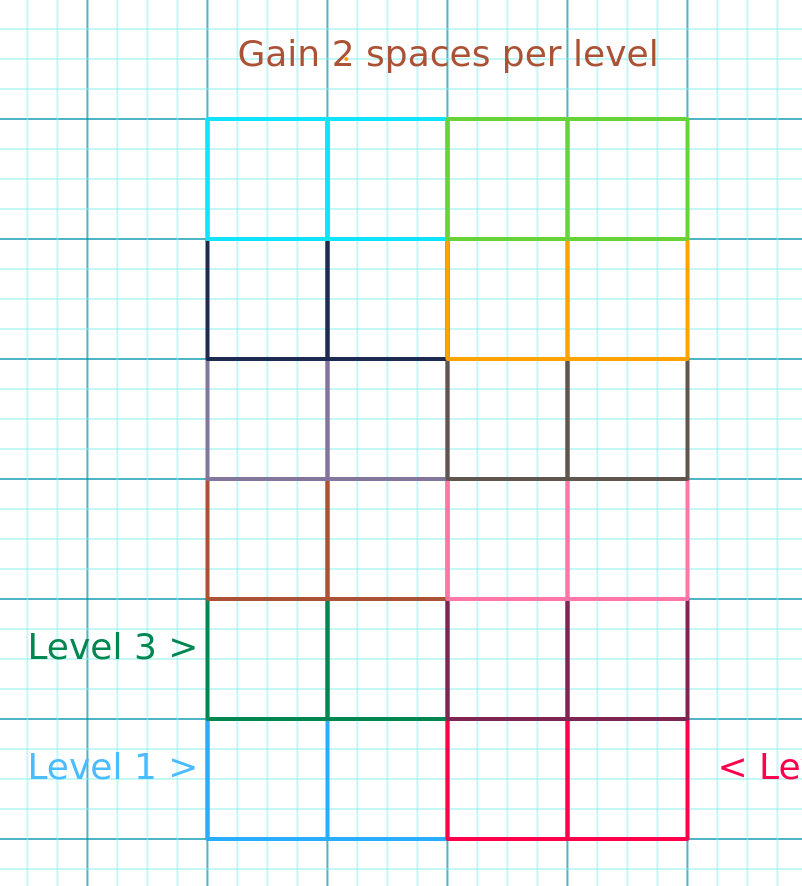
Anyway, check this out: 
 
grid paper with different color boxes, 2 of each color side by side. it is 4 boxes wide and 6 boxes high, which results in there being 12 different colors. text above reads: Gain 2 spaces per level. text to the left of the bottom left box reads: Level 1. text to the right of the bottom right box reads: Level 2. text to the left of the second to bottom box reads: Level 3.

So you start with two boxes of space for spells. If you're playing a game with cantrips, maybe those would take up one box, allowing you to memorize two relatively weak, non-damage dealing spells. A level 1 spell like Sleep would take up two boxes. Maybe level 2 spells would take up 3 squares. From there, spells could start taking the shape of tetrominos, like the ones in Tetris.

the five tetrominos, a geographic shape composed of 4 squares.
By Anypodetos - Own work based on: Tetromino Tiling 5x8.svg by R. A. Nonenmacher., CC BY-SA 3.0, https://commons.wikimedia.org/w/index.php?curid=8663361

Even more advanced spells could take the form of pentominos, like this:

the 18 pentominos, plane polygons made of 5 squares of equal size connecting edge to edge

The spell-caster finds or copies spells into their book, each spell has a shape, and every day the conjurer pours over their spellbook, rotating and arranging their spell choices to fit into the canvas of their mind. 

Is it practical? Hell no. Would it be fun? Highly subjective. Would the spells leave your brain once cast, like Vancian magic? Who knows! Has it been done before? Probably! But I'll be damned if I could find it.


Saturday, February 22, 2025

Another Kind of Factions

This one's a draft of faction rules using Otherkind Dice. Which is to say, I haven't tried it. Yet.

I love factions. They're like the MSG of roleplaying games, their inclusion makes everything taste better. I also adore when a game has GM turns that happen in-between sessions. Especially when there's mechanics involved. For me, few things make prep more fun than getting to play a little mini-game during it. 

Recently I was looking at the faction rules in Mausritter. They're great! The goal progression results reminds me of an Otherkind result card, only there's just one question being answered. Which is elegant in its simplicity, but got me to thinking, "what would other result cards look like?"

Design Goals
"What am I trying to accomplish?" is a wonderful question to ask yourself repeatedly when you design something. It's can be easy to get the ball rolling, and even easier to continue chasing it to straight to catastrophic failure. I can't tell you how many times I began working on something, followed inspiration, incorporated it into a game night and went, "well, that sucked." So I started with that north star query.

"Make a faction system that tracks fallout and debt as factions make moves." There it is. I want something that determines how the public and other factions (enemies and allies) react to a faction moving toward their goal. I want factions to be able to interact with one another via debt. 

Faction Stats
As far as this system is concerned, factions have resources, goals, public reputation, faction reputation, and debt.

Resources are what factions use to accomplish their goals. They could be something concrete like a cavalry troop, or intangible like blackmail on members of the high council. Resources come into play in the form of dice, which is determined by the strength of the resource. They can either be standard (d6), diminished (d4), or enhanced (d8). Factions start with two or three resources, depending on their size.

Goals are, naturally, what the faction is trying to accomplish. I would use clocks, or progress marks as Mausritter calls them, ranging between two and five segments (or marks). If a goal seems too big to accomplish in five segments, then it should be broken up into a series of goals. "Usurping the king," for instance, probably has a few smaller goals before a faction could achieve the big one. 

Public reputation is the general attitude of different populations toward a faction. I imagine this to be regional. A thieves guild might start off with a favorable attitude with farmers in the countryside ("stick it to those richie-riches in the city!") but disfavored by the citizens in the city they operate ("that's my purse! I don't know you!"). It could also be done on a smaller scale, like a church that the lower class of a city adore for their charity but the upper class resent for their tithes. 

Faction reputation is how factions feel about one another. I can think of two ways to implement this. The first is simple: two factions always feel the same about one another. So if one faction views another as the enemy, the opposing faction does as well. The other is more complex, and a faction's attitude toward others is independent of their attitude toward them. This would require more bookkeeping, but would result in things like Faction A viewing Faction B as an ally, while Faction B sees them as an enemy and works surreptitiously to undermine them. That sounds cool as hell to me! 

Either way, both public and faction reputation would be tracked numerically. 0 being neutral, with -6 and +6 representing hated and loved respectively. For public reputation, the score would help me roleplay NPCs the players encounter. For faction reputation, it would both help me roleplay faction NPCs and also make decisions during the faction turn. If Faction A has a -3 reputation with Faction B, Faction B is going to interfere with Faction A's plans when convenient. If it's -6 instead of -3, Faction B is going to interfere at every possible opportunity. If it's a +6, Faction B might abandon goals that run counter to Faction A (especially if B is the smaller faction). 

Debt is what it sounds like. One faction can ask another to lend resources. They then take on a debt, which is repaid by lending their resources to the faction that helped them. It's a way to incorporate and track the political machinations of these organizations in their quests for power. More on how debt actually works below.

Does that all make sense? I hope so. Anyway, how do we actually play the mini-game? We grab some index cards, some dice, and prepare for...

The Faction Turn
Factions act in-between sessions, lowest number of resources to highest. Smaller organizations are able to mobilize and act more quickly, but larger factions are able to interfere more easily because of this. 

At the start of a faction's turn, they pick a goal to make progress toward. Then, they select any number of their resources they could reasonably use to accomplish that goal, and grab the appropriate dice. Don't roll yet!

If they do not have enough resources to answer every index card, or they want a better chance of success, they may enter into debt or call in what is owed with another faction to add more dice. They may enter minor debt (d4, owe them 1 time) or major debt (d6, owe them 2 times). If they have negative reputation with the faction they ask for help, double what is owed in return, but once the debt is repaid their faction reputation increases by 1 for a minor debt, or 2 for a major debt. Calling in a debt gives the lender equivalent sized dice to what the debtor received.

Lastly, factions can interfere before the roll is made. For every resource die an interfering faction decrements in size, they can likewise decrease a resource the acting faction is using this turn. 

Now, on to the result cards. Roll the dice and place as you wish. 

Notes: Unless otherwise stated, a new resource acquired from accomplishing a goal starts as diminished (d4) for two turns. Likewise, any enhanced resource (d8) automatically decrements to standard (d6) once it it used.

Does the faction make progress towards their goal?
7+: Yes, major progress (2 segments), and if this results in acquiring a new resource it begins at standard (d6).
6: Yes, major progress (2 segments).
3-5: Yes, minor progress (1 segment).
0-2: No, they suffer a setback (-1 segment).

Does the faction exhaust resources working toward their goal?
7+: No, they don't, and if an enhanced resource (d8) was used, it does not decrement.
5-6: No, they don't.
3-4: Yes, one is diminished next turn.
0-2: Majorly. Two are diminished, or one is diminished for two turns.
If the resource chosen to be diminished is already a d4, that resource is lost instead.

How does it affect their reputation with the public?
7+: Public opinion in the area skyrockets (+2 rep), and word of this is received well elsewhere (+1 rep with another population).
5-6: Public consensus in the area is positive (+1 rep).
3-5: It's split. Some see it as good and others use it as further fuel for their mistrust or animosity (no change).
0-2: The public consensus is negative (-1 rep). 

How does it affect their reputation with other factions?
7+: As 6, but +2 rep with one ally and +1 rep with one enemy.
6: Allies react positively (+1 rep), enemies are neutral (no change).
3-5: If a debt with them was entered, they react positively (+1 rep). Otherwise, allies are neutral and one enemy is upset (-1 rep).
0-2: One ally reacts negatively (-1 rep), and one enemy is incensed (-2 rep). 

There it is! As you can see, there are four index cards to answer. Factions start with a maximum of three resources, which means they will either be incurring debt immediately or facing the harshest consequences for their moves. Likewise, each card has a 7+ result that can only be gotten by placing an enhanced resource (d8) there. 

Like I said up top, I haven't tested this yet. It existed as a couple of paragraphs on a notes app in my phone before I typed it all out into this post. Now that I don't have to ask myself, "what did I mean by that?" I can give it a go. There are some questions I don't have an answer to yet, like, "does lending a resource take it out of play for the turn?" I hope to get my answer by trying it both ways and seeing for myself how it feels. I'm excited to take it for a spin in solo play before bringing it to one of my tables. Hopefully it inspired you to think about different ways you can run factions. And if you happen to try this way out yourself, let me know how it goes!


Sunday, February 9, 2025

Life is Likely Hurt & Pain

Here in
DUKK BÖRG.

This one's a review. Of DUKK BÖRG by Gem Room Games and Nerdy Paper Games. It's a DuckTales-themed hack of MÖRK BORG.

Let's get the disclaimer out of the way first. This is about as biased as as a review as you're likely to find. One, Dan Phipps of Gem Room Games and I have been mutuals on social media for a few years at this point, I don't remember how many. Talking about games with Dan is a blast. I'm probably going to go into any of his work expecting to enjoy it, even if it's not particularly my jam.

This, however, is extremely my jam. I grew up on a steady diet of DuckTales, Darkwing Duck, Chip & Dale's Rescue Rangers, and Sonic the Hedgehog. You give me a game where I get to play around in those worlds, I am all-in. Hell, just let me be a duck or a mouse, even! I spent an embarrassing number of hours in 2020 playing Animal Crossing New Horizons looking like this:


Like, hundreds of hours.

Speaking of which, I should probably pick up Dragonbane at some point. 

Anyway, I bought DUKK BÖRG. Then I read it. Then I played it. Let's get into it.

Part 1: The Book

I backed the physical copy of the book when it went to crowdfunding. It's pretty, in the creepy way that many BORG games are. They nailed that MÖRK BORG-style layout, and between that and the art, it is very fun to look at. It is also less-practical to use at the table because of this. The book has a handy index on the inside back cover, and I saw they have a plain-layout pdf as well. I have ran plenty of MÖRK BORG only using the physical book, so this wasn't a hurdle for me. I could see it being a barrier to entry for others, though. 
 
This thing is fun to read. It is as stone-faced as it is silly. It dares you to take it as seriously as it takes itself (more on that later). The classes, locations—even the magic items—are rife with adventure hooks. The classes themselves nail the cartoon's archetypes, as does the equipment. Those world-ending psalms that are a hallmark of BORG games are just the DuckTales theme song. And like the theme song, they are repetitive. That might wear on anyone brave enough to live in this cartoonish hellscape for long-term play, but the text is challenging you to look at your players with a straight face and tell them what new thing is heralding the apocalypse with an oo-woo-ooo. 
 
Included is an adventure, The Aeonian Citadel. I ran it for the Tuesday crew, so without further ado...
 

Part 2: The Play

There are going to be some spoilers for the adventure. You have been warned!
 
My Tuesday table currently consists of three of my friends I have been playing games with for 8 to 20-ish years. One has played MÖRK BORG with me, the others have not.
 
They ended up making a Treasure Hunter, a Gizmo-Speaker, and a Devotee. Each of them had at least two classes they were interested in playing, deciding on one might have been the hardest part for them. One ended up rolling for it. The clan creation was a highlight for me, and a great way to tie the player characters together. I let them spend their starting silver on gear because the adventure plops you right in front of the dungeon and doesn't really let you leave. 

The dungeon itself is SKRUJ's tower, and it extends up into the sky and down into the earth. The length of it is indeterminable, because travel between each keyed floor includes a random number of unimportant floors. Unimportant, that is, unless there's a random encounter on them. My players got really lucky on those rolls, but luck has a funny way of running out.
 
See, the thing about the tower is that it's a race against time, but time only passes when the characters smell money. There are set, keyed money encounters, but they can also happen during a random encounter. If you smell money too much, game over. Once my players figured that out, the sense of foreboding only increased. 
 
Therein lies the beauty of DUKK BÖRG. The game, and by extension the starting adventure, is so full of Saturday morning zaniness that we ended up laughing and joking around. But it all rests on the bones of the incredibly dangerous MÖRK BORG skeleton. So it might be a funny mental image when a troupe of primary-color wearing ducks with slingshots pop out of a vent, but when it hits you that this is a life-or-death situation the game asks, "who's laughing now?" Like I said before, it dares you to take it seriously. There are consequences for not. 

My players decided to descend the tower, and I encountered my only hiccup in running it. See, I had read the entire dungeon when I first received my physical copy last November, but I only skimmed it before playing it last Tuesday. One subterranean floor has a freezer. 
 
The book tells you what temperature the freezer is at, and another section has a consequence for unplugging it. There's a cryptic label with letters missing on the freezer. Neither myself nor my players could figure out what was in the freezer. I'm not sure if the incomplete label refers to something in the real world, something from the DuckTales cartoon, or something I was supposed to come up with. It put me on the back foot, which was frustrating in the moment. In hindsight, I wish I had read through the adventure again in full and expanded on that dang freezer. 

But that was just a road bump during an otherwise action-packed, laugh-filled evening with my friends. Each keyed dungeon floor they explored was interesting, the multiple encounter tables kept things fresh, they even ended up finding some cool magic items. One of the players forgot he had a pet lemming for half the session, but I've never played a game where a player's pet isn't forgotten about. 
 
They made it to the very bottom vault of the tower, but didn't make it back to the ground floor before becoming indoctrinated cogs in the corporate machine. We faded on them shuffling off, holding orientation papers in their feathered hands. I couldn't think of a better end to our brief time in this fowl world. 

I asked my players if they'd like to take another run at the adventure sometime in the future, when we want a break from whatever else we're playing. After all, they only explored half of the tower. They immediately started hatching their next plan.

I'm excited to return to the Accursed City, because DUKK BÖRG isn't just a pun, it's a pun that's playable. I don't think I can give any higher praise. 


Wednesday, January 22, 2025

Solokind Negotiation

This one's about using Otherkind Dice in old-school solo play.

My love for Meguey & Vincent Baker's index card dice system is no secret. Recently, I've been gearing up to do some solo dungeon/hex crawling. It seems like a fun way to pass an hour or two, and if it ends up resonating with me I'd like to join the ranks of people running sandbox campaigns for their friends that they also play solo in between sessions. 

As I prepare for my descent into The Incandescent Grottoes, I took stock of what I need. There are many fine products for one-player games—GM oracles, spark decks, etc. I'm using a procedure-heavy game and published material, so I don't really need help with content generation. The one thing that puzzled me was how I was going to treat with the dungeon denizens I encounter. 

I looked around for ways other people have handled this situation. Maybe I didn't look hard enough, but I didn't find much of anything. I'm sure there are brilliant solutions out there, just out of reach of my search-engine skills. So I had to think of how I'd do it. And naturally, I thought of Otherkind Dice. 

Negotiation
When you negotiate with an NPC, use the following three index cards. Roll 3d6 and assign one die to each card. Add your reaction roll modifier (Charisma) to one of the results. If a negative reaction roll modifier would give you a result of zero, treat it as a 1.

What do they want?
6: Help achieving a small goal.
4-5: Something material and common.
3: Help achieving a large goal.
1-2: Something material and rare.

What will they give in return?
6: More than you're asking for.
3-5: Exactly what you're asking for.
1-2: Less than you're asking for.

How will this affect your reputation with them?
6: A great increase in reputation.
3-5: A modest increase in reputation.
1-2: No increase in reputation.

I think Otherkind Dice are a powerful tool for the solo roleplayer. I imagine a solo game only using them could work quite well. I can't wait to continue my solo journey and find other hurdles to overcome with a few index cards and some six-sided dice. 


Monday, January 20, 2025

Wrestling with a White Whale

This one's about grappling.

Has any ttrpg done grappling well? I'm sure some have, just as I'm sure every edition of the world's most popular roleplaying game that includes grappling rules is not among them. Rise Up Comus said as much yesterday on Bluesky, and it got me thinking... how would I do it?

That question opened up a majestic can of worms (sorry, I'm so sorry). What do I want from grappling rules? Well, I want them to be fast. But not too fast, one-and-done is anticlimactic. Dice rolls should be involved, however. In contested rolls! That way my players and I can narrate the back-and-forth as each side struggles for the upper hand. And it should be simple, something I could explain in about 30 seconds. 

Here it is in much more, "these are game mechanics" language. 

A Grappling Contest

These rules use a dice chain (d4>d6>d8>d10>d12>d20). 

When one character attempts to grapple another, a contest is started between them. Each contestant starts with a grappling die, which is a d8 by default. The die is incremented one step for each advantage a contestant has, such as a difference in size, abundance of limbs, etc.

The contest is a series of rolls using the grapple dice. Any to-hit melee bonus or penalty from a contestant's Strength score is applied to the roll. Each time one side loses, their grapple die decrements one step. When a contestant no longer has a die to roll, they have lost and are grappled. 

Well, there you have it. I haven't tested this, besides grabbing some dice at my kitchen table. It seemed fun to me, I could imagine the back-and-forth action that I want out grappling mechanics. Will it be fun for my players? Only time will tell. 


Wednesday, January 15, 2025

Smoke & Mirrors

This one's about suspension of disbelief, or rather when I fail at it.

Torches in old-school roleplaying games are magic items masquerading as mundane ones. With some exceptions, every torch lasts a set amount of time—usually an hour. Dungeons are often pitch-black and filled with beings adapted to seeing in such places. Yet the light of a torch doesn't attract the subterranean denizens as the delvers explore, illuminating halls and rooms as they go*. Neither does the smell of smoke, apparently.

The smoke! Don't get me started on the smoke. You're telling me dungeon crawlers light a fuel-soaked cloth attached to a stick to explore confined underground spaces? While moving maybe 120' every ten minutes? At worst, it sounds like a great way to speedrun suffocation. At best, it's going to be very difficult to see your surroundings. Because of all the freaking smoke. 

As I mentioned and you likely already know, torches are made from wood. Preferably resinous so the handle of your fire-stick doesn't burn as well. Then you need a cloth—burlap or something similar—soaked in a fuel (e.g. pitch, lard, oil), and fastened to the stick with something that doesn't easily burn, like wire. Maybe the fuel is a pitch or animal byproduct that doesn't produce smoke. Maybe it's common in the fantasy world the game takes place in. But from where I'm sitting it sounds supernatural.

So torches are magical. Or some parts of them are, because what other explanation is there? 

What does the availability of torches imply about the game world? About the labor of said world? How many people are involved in the production of the material components of a torch? And who puts them all together? Is there an infinite supply of them at every town and village? I suppose they may be a popular method of indoor lighting if they're the smokeless variety we see in tv and movies. Or do they only work that way out in the dangerous depths few dare to tread? Are adventurers really few and far between, or does the existence of an ample supply of torches imply a bustling industry of ne'er-do-wells? 

Look, I get it. Everything about torches are an abstraction, one of many found in these games. We could use candles or rushlights, but they're variants with the same problems on a smaller scale. Besides, we're not playing medieval life simulators. Torches exist for resource management, in the light they provide and the inventory space they take up.  But unlike nearly every other abstraction common throughout old school games, this one leaves me with more questions than answers.

So I can't think about torches. But I also can't stop thinking about torches. They aren't really a problem that needs to be solved, yet I still want to solve it. Thankfully, Dan Phipps and I did so a few months ago on Bluesky. You're welcome.

*The referee could, of course, have torch-use be the reason behind random encounters when they happen. But that isn't explicit in most games' procedures. And in a game like Shadowdark, it's actually less likely you'll encounter a wandering monster if you have a light source.

Thursday, December 26, 2024

x-in-6 Roll to Retain Spells for OSE, et al.

This one is an untested idea.

What if the spell slot tables for casters in OSE and other such games was instead their x-in-6 chance of retaining spells of that level after casting it? 

Okay, surely this has been done before, right? But if anyone's talked about it online, I could not find it. If you know of anywhere this already exists, feel free to let me know in the comments. If you've tried it yourself, by all means share your experiences!

Anyway, I will likely give this a go the next time I run a game in the B/X family. Vancian magic is probably my players' least favorite part of games that use it, and I'd like to see the fun they'll have casting every spell they know at least once, maybe more, a day. Would this get messy in high-level play? Probably, but we've never reached high level before wandering over to another game. I'll cross that bridge if we come to it.  

Also, I much prefer roll to retain vs roll to cast. My tables have played roll to cast games a bunch over the years, and none of us particularly enjoy that aspect. I've taken to houseruling roll to retain into any such game we play. Null results won't stop me from playing something, but the less there are the better if you ask me.

P.S. Yes I know in Old School Essentials that would mean a 14th level Cleric would be able to cast infinite level 1 spells. That sounds really cool to me. 


Tuesday, December 24, 2024

x-in-6 Fighter Maneuvers for OSE

This one does what it says on the tin.

Damage and a maneuver? In this economy?! Well, yes. Inspired by the d6 thief skills in Carcass Crawler #1 by Necrotic Gnome, the house rules used in the 3d6 Down the Line Actual Play, and of course Mighty Deed of Arms from Dungeon Crawl Classics. I used it when I ran Old School Essentials earlier this year. Here's what it looks like.


Prowess

If a Fighter succeeds at an attack, in addition to dealing damage they can attempt one maneuver. The maneuver has to make sense; you couldn’t, for example, trip a flying opponent or a Gelatinous Cube.  
Push: Push the opponent 5 feet.
Trip: Knock the opponent prone.
Disarm: Strip the opponent of their weapon.
Intimidate: Force a morale check, as long as the opponent has not already passed two of them.
Ensnare: Prevent the opponent’s movement next turn.
Taunt: The opponent gets -2 to attacking anyone but the Fighter.

Each maneuver starts at a 1-in-6 chance. At 1st level, a Fighter has 6 expertise points to allocate.Every odd-numbered level thereafter, a Fighter gains 3 points to allocate.


Now, you may be asking yourself why. For many, the OSE (or B/X) Fighter is perfect as-is. If that's the case for you and your table, that's wonderful. However, mine is not convinced by the, "but they get magic swords!" argument. Especially when you consider the Fighting-Men in OD&D got all that and a bag of chips*. Besides, I love house-ruling and hacking the games I play with my friends. We have specific tastes, myself most of all, and our enjoyment takes precedent over a dogmatic adherence to the written word.

Others may be asking why as in, "why not just use Mighty Deed of Arms from DCC?" Some of my players struggle to come up with things when given something so open-ended. The structure of having six maneuvers to choose from emboldened their creativity. And the others pushed the boundaries of those limits, as they always do in any similar situation.

In other words, it worked for us. If you think it'd work for you and yours, try it out and let me know how it goes.

*Literally always being better at fighting than the other two classes, including multiple attacks much sooner if you used Chainmail.


Sunday, December 22, 2024

Speedrunning Combat

This one's about using Otherkind Dice in old-school play.

There are two things I love. The first is the aforementioned Otherkind Dice by Meguey & Vincent Baker, without whom this post wouldn't exist*. I think about those dice a lot, maybe once a week. My game design drafts are full of possible ways to use them. 

My second love is combat in old-school roleplaying games. It's dangerous, but it rewards planning, creative item use, etc. Also, compared to modern fantasy games, it's fast. Still, there are things that slow it down, like turns/phases/actions, to-hit rolls, hit points, etc. Some games out there even do away with some of these things to speed it up. I love that, too.

But what if there was something that kept what I like about old-school combat, but was even faster? Like, really fast? What if OSR stood for Otherkind School Revolution? Maybe it would look like this:

Combat
When two forces clash and it is obvious who would win, they do. The GM will say what the consequences for the losing side are.

Otherwise, grab 3d6 and consider the following:
-Do the player characters have tactical advantages (high ground, surprise, superior numbers, etc)?
-Are the player characters using items to bolster their chances (molotovs, caltrops, oil, an optimal weapon, etc)?
-Are the player characters using magic to tip the odds in their favor?

Add a d6 for each advantage, item, or magic the characters employ. Then, answer the same questions for the opposite side. Take away d6 as appropriate.

The players then roll the remaining d6 and assign results to the following tables/index cards:

Characters
Were the player characters injured?
0: They were all killed or captured, at the GM's discretion.
1-2: One of them was killed or captured at the GM's discretion. determine randomly if no one volunteers. The rest were injured.
3-4: Half of them were injured, one gravely so. Determine randomly if no one volunteers.
5: One of them was injured.
6: Miraculously, none of them were.

Resources
Were any of the items or spells they used lost or broken?
0: Yes, all of them.
1-3: Yes, half of them. Determine randomly if no one volunteers.
4-5: Yes, one of them. Determine randomly if no one volunteers.
6: Somehow, not a single one.

Enemies
How did their opponents fair?
0: Completely unscathed.
1-2: They suffered minor injuries.
3-4: Half of them were injured, one gravely so.
5: Half of them dead, captured, or fled—players' choice.
6: Completely routed. they are all dead, captured, or fled—players' choice.

Now, how would I hack this into a pre-existing game like B/X? Perhaps I'd add a d6 for each THAC0 score improvement. Multiple d6 if Turn Undead was used against low-HD opponents, that could probably work. I'd probably just start playing with it and come up with solutions as they arose.

But I'm more interested in what a new game that uses this combat would look like. Would it use Otherkind Dice for everything? I'm of two minds about that. Games that have a single resolution mechanic are usually easier to pick up and play. Grab some d6s and the relevant index cards and you're set. That sounds fun! On the other hand, Otherkind works best when there's at least three result cards in play whenever a roll is called for. It could be a challenge to make a game that includes everything I want to leave to chance while also only rolling when the situation is complicated enough to warrant three result cards. 

And then there's the ritual of it all. This is hardly new territory, but resolution mechanics are rituals we enact while playing make-believe. And even if we can resolve everything in a game by flipping a coin or rolling a d20 and adding a number, there is something fascinating to me about the various parts of a game using different rituals to find out what happens next. 

Anyway, I'm excited to continue tinkering on an old-school game that speedruns combat. I'm sure I will come up with enough of something to play with my friends. I already have a near-complete draft of overland travel on a hex map that uses Otherkind Dice. Maybe you'll see that in a future post. 

*I originally posted about this on Bluesky. I was encouraged by Amanda P to blog about it, so credit to them for this entry as well.

Just Make 'em Human: Elves

This one's about re-imagining elves as a human culture.  One of the issues I have with fantasyland, and oh there are many, is that human...